20 Years Of Focus · Trustworthy Supplier of ultrasonic welding and plastic welding process scheme
Consultation telephone: 0510-88211896

Consultation telephone: 0510-88211896

Ultrasonic plastic welding is a widely used joining technology in modern manufacturing. It enables thermoplastic components to be joined quickly and efficiently without traditional adhesives, screws, or other mechanical fasteners.
From automotive interior components and electronic housings to medical devices and household appliances, ultrasonic welding offers manufacturers a reliable solution for producing strong, consistent, and repeatable plastic joints.
However, achieving high-quality welds requires more than simply selecting an ultrasonic welding machine. Material compatibility, component design, welding parameters, tooling, and automation all play important roles in the final result.
In this guide, we explain how ultrasonic plastic welding works, where it is used, how to select suitable equipment, and what manufacturers should consider before investing in an ultrasonic welding solution.
Ultrasonic plastic welding is a joining process that uses high-frequency mechanical vibrations to generate localized heat at the interface between compatible thermoplastic components.
During the welding cycle, an ultrasonic generator converts electrical energy into a high-frequency signal. A transducer converts this electrical energy into mechanical vibrations, which are transmitted through the welding system and applied to the plastic components by a specially designed horn, also known as a sonotrode.
The vibration and applied pressure generate heat at the joint interface, causing the plastic to soften or melt locally. When the vibration stops, pressure is maintained while the material cools and solidifies, forming a joint.
A typical ultrasonic plastic welding system consists of:
Ultrasonic generator
Ultrasonic transducer
Booster, where required
Welding horn or sonotrode
Pneumatic or servo-driven actuator
Dedicated welding fixture
Control system and safety devices
The performance of the complete system depends on how these components work together with the product design and welding process.
A typical ultrasonic welding cycle includes four stages.
Stage 1: Component positioning
The plastic components are placed in a dedicated fixture that supports the parts and maintains the required alignment.
Stage 2: Vibration and pressure
The welding horn contacts the upper component. High-frequency mechanical vibration is applied while the actuator generates the required welding force.
Stage 3: Energy transfer and joint formation
Localized heat develops at the joint interface. The material softens or melts, allowing the designed joint features to fuse.
Stage 4: Holding and cooling
The vibration stops, and pressure is maintained for a controlled period. The joint cools and solidifies before the machine releases the components.
Welding parameters may include amplitude, welding force, energy, time, trigger position, and holding time. The appropriate control strategy depends on the material, component geometry, joint design, and production requirements.
Ultrasonic welding is particularly suitable for many thermoplastic materials. However, not all plastic combinations can be welded successfully under the same conditions.
Common materials include:
ABS: commonly used in electronic housings and automotive interior components.
Polypropylene (PP): used in automotive parts, household products, and industrial components.
Polycarbonate (PC): used in selected transparent and structural components.
Polyamide (PA): used in engineering plastic components.
Polystyrene (PS): used in housings and consumer products.
Selected thermoplastic blends and compatible material combinations.
Material compatibility, moisture content, fillers, wall thickness, and component geometry can all affect welding performance.
For example, welding two ABS components may require a different process setup from welding two polypropylene components. Joining dissimilar materials requires additional evaluation because their melting behavior and compatibility may differ.
For critical applications, sample welding and process validation should be completed before finalizing the equipment design.
Automotive manufacturers use ultrasonic welding for various plastic components, including:
Door panels and interior trim
Instrument panel components
Air-conditioning ducts
Plastic housings and brackets
Selected lighting and functional components
For automotive production, multi-head ultrasonic welding machines and robotic welding systems can help achieve consistent joint quality across multiple welding locations.
The appropriate solution depends on the number and position of weld points, cycle time, component dimensions, and production volume.
Ultrasonic welding is used for selected electronic housings, connector components, sensor enclosures, and electrical product assemblies.
When designing a joint for electronic components, manufacturers should consider internal clearances, component sensitivity, sealing requirements, and the potential transmission of vibration through the assembly.
Certain medical products and disposable components use ultrasonic welding to join compatible thermoplastics.
Applications may include selected housings, fluid-handling components, and disposable assemblies. Medical applications require appropriate process validation, cleanliness controls, and product-specific quality requirements.
Ultrasonic welding can be used for plastic housings, small appliance components, containers, and various consumer products.
It is especially useful when manufacturers need a repeatable joining process that can be integrated into automated production.
Choosing the right machine configuration is essential for achieving the required quality and production efficiency.
Standard Ultrasonic Welding Machines
Standard machines are suitable for many individual welding applications. They are often used for product development, smaller production runs, and applications with relatively straightforward tooling requirements.
Multi-Head Ultrasonic Welding Machines
Multi-head machines are designed for products that require welding at several locations.
Depending on the application, multiple welding units can reduce the need for separate operations and improve production efficiency. The design must account for force distribution, tooling rigidity, vibration interaction, and consistent contact across all welding points.
Robotic Ultrasonic Welding Systems
Robotic systems are suitable for larger components, complex weld-point layouts, and flexible production requirements.
They can be integrated with dedicated fixtures, automatic loading systems, safety equipment, and production-line controls.
Customized Ultrasonic Welding Automation
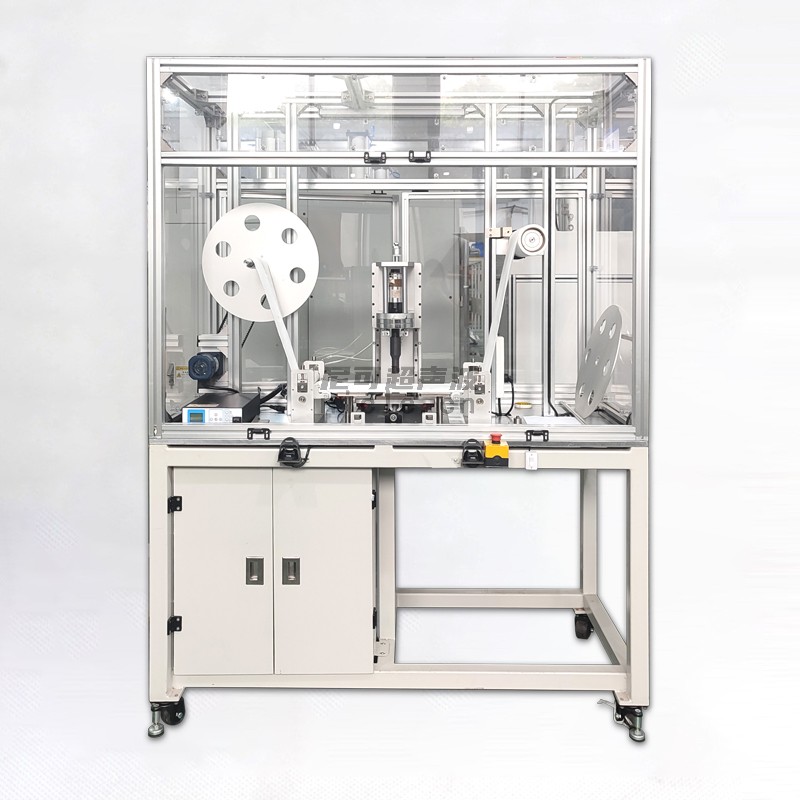
Some products require a dedicated machine rather than a standard model. Customized solutions may include special fixtures, multiple welding heads, automatic positioning, product detection, recipe management, and changeover systems.
The best configuration should be determined by the product geometry, process requirements, expected output, and available factory space.
Before selecting equipment, manufacturers should evaluate several key factors.
1. Plastic material
Identify the material grades of both components, including any fillers or additives. Material compatibility should be assessed before equipment selection.
2. Product dimensions and geometry
Large components, thin walls, complex shapes, and long weld lines may require special horn designs, additional support, or alternative joining processes.
3. Weld-point quantity and position
The number and location of weld points influence the selection between a single-head machine, a multi-head system, or a robotic solution.
4. Required joint strength and sealing performance
A product requiring structural strength or leak resistance needs an appropriate joint design and a clearly defined validation method.
5. Production cycle time
The target output determines whether a manual, semi-automatic, or fully automated solution is appropriate.
6. Quality control and traceability
For demanding applications, the system may require displacement monitoring, energy monitoring, pressure control, weld-data recording, and product identification.
7. Tooling and future product changes
If the same machine will be used for multiple products, consider fixture replacement, horn changeover, parameter storage, and setup repeatability.
A machine should be selected based on the complete application rather than its nominal power rating alone.
Even when suitable equipment is used, improper tooling or process parameters can lead to inconsistent results.
Weak weld strength
Possible causes include unsuitable joint design, insufficient energy transfer, incorrect welding force, material incompatibility, or inadequate holding time.
Recommended approach: inspect the joint geometry, verify the material specifications, and conduct controlled parameter trials.
Excessive flash or deformation
Possible causes include excessive vibration amplitude, inappropriate welding force, excessive energy input, or inadequate fixture support.
Recommended approach: optimize the process parameters and improve the fixture and joint design where necessary.
Inconsistent welding across multiple points
Possible causes include uneven contact, insufficient tooling rigidity, differences in weld-point geometry, or uneven force distribution.
Recommended approach: evaluate the complete tooling structure and confirm that all welding heads contact their intended locations consistently.
Damage to internal components
Possible causes include vibration transmission, unsuitable support structures, or excessive process energy.
Recommended approach: assess the component structure, optimize the joint location, and validate the process using representative samples.
The correct solution should be determined through systematic testing rather than changing parameters without identifying the underlying cause.
Standard equipment can address many applications, but complex products often require application-specific engineering.
A customized solution may combine ultrasonic welding technology with dedicated tooling, pneumatic or servo-driven motion, multi-head configurations, robotic handling, and automated inspection.
For automotive plastic components, a well-designed system should consider not only welding performance but also fixture repeatability, operator safety, changeover time, production-line integration, and long-term maintenance.
Working with an experienced equipment manufacturer early in the product development process can help identify potential joining problems before the production machine is finalized.
A practical project usually begins with the product and process requirements rather than a machine quotation alone.
To evaluate a potential application, prepare the following information:
Product drawings or 3D CAD files
Plastic material specifications
Product dimensions and approximate weight
Weld-point locations and joint requirements
Required cycle time and production volume
Strength, sealing, or appearance requirements
Available installation space and automation preferences
With this information, the equipment manufacturer can evaluate the application, recommend a suitable machine configuration, design the tooling, and arrange sample welding trials where appropriate.
For critical applications, the proposed process should be validated against agreed product acceptance criteria before production release.
Ultrasonic plastic welding provides an efficient joining method for many thermoplastic manufacturing applications. Its effectiveness depends on the correct combination of material selection, joint design, process parameters, tooling, and equipment configuration.
Whether the application requires a standard ultrasonic welding machine, a multi-head system, robotic welding automation, or a customized production line, early engineering evaluation is essential for achieving reliable results.
A successful ultrasonic welding project is not simply about purchasing a machine. It is about developing a joining solution that meets the product's technical requirements and the manufacturer's production goals.
Looking for an ultrasonic plastic welding solution?
Contact our engineering team with your product drawings, material information, and welding requirements. We can evaluate your application and discuss a suitable equipment configuration, tooling concept, and process validation plan.
Article label:

216 Xitai Road, Xinwu District, Wuxi City, Jiangsu Province, China

(+86) 181 6892 0913

chen@nicle.cn
 Product Center
Mash welder Plastic welding Automobile Metal welding Hot plate welding Hot melt welding Hot riveting Ultrasonic mould
 Contact Us


+86 18168920913






 National Service Hotline